
Flexographic Printing on Tissue and Packaging Paper
Where the Project Takes Shape
Printing is the stage where every decision made during pre-press becomes a tangible product.
Paper selection, format, colour specifications and production settings all come together in a process designed to deliver quality, consistency and long-term repeatability.
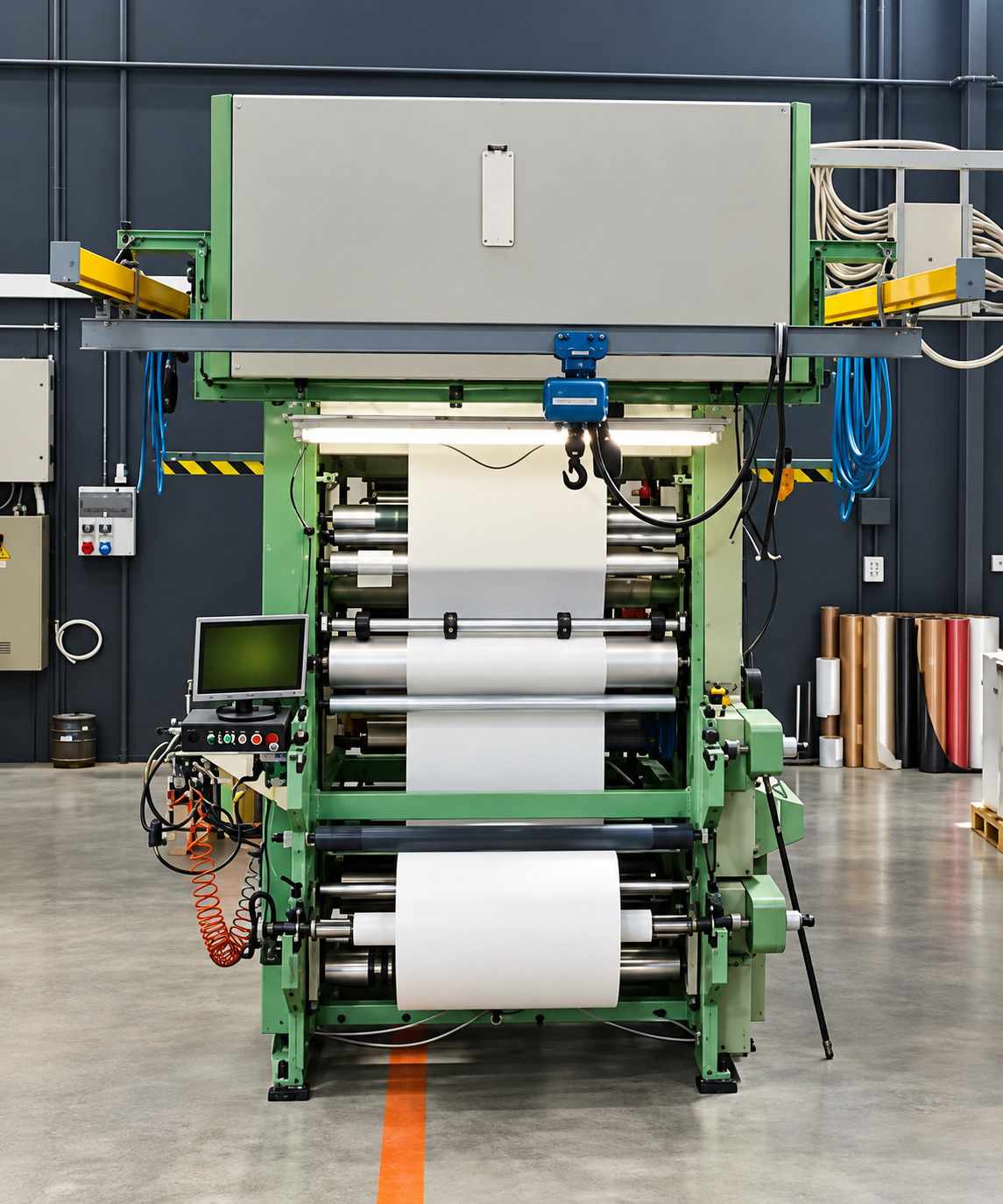
For the production of custom printed papers, we primarily use flexographic printing, a technology that has evolved into one of the most reliable and efficient industrial printing methods available today.
Flexography is particularly suited to lightweight papers, tissue paper and continuous production runs where consistency is essential.
What Is Flexographic Printing?
Flexographic printing uses a raised printing plate known as a cliché.
The flexible plate is mounted around a printing cylinder and receives ink before transferring it directly onto the paper substrate through carefully controlled pressure.
This process is often referred to as “kiss printing” because the printing plate touches the paper with only the minimum pressure required to achieve a clean ink transfer.
The result is a highly efficient printing process capable of maintaining excellent quality even on delicate substrates such as tissue paper.
The Importance of the Anilox Roll
One of the key components of flexographic printing is the Anilox roll.
This precision-engineered cylinder contains thousands of microscopic cells that control exactly how much ink is transferred to the printing plate.
Different applications require different Anilox configurations.
Higher cell counts allow for finer details, smaller text and more complex graphics.
Lower cell counts transfer larger ink volumes, making them ideal for solid areas and highly opaque backgrounds.
Selecting the correct Anilox specification is a critical factor in achieving optimal print quality.
Built for Consistency
In custom paper manufacturing, printing well once is not enough.
The real challenge is achieving the same result across every production run.
Industrial printing therefore relies on carefully controlled processes that ensure colours, densities and graphic details remain consistent over time.
This repeatability is essential for protecting and maintaining brand identity.
Up to Six Printing Colours
Our presses can print up to six colours.
This allows us to produce:
- Line artwork
- Single-colour logos
- Multi-colour graphics
- Solid backgrounds
- Full-colour images
- Dedicated spot colour combinations
Each project is developed according to the desired visual result and the characteristics of the chosen paper substrate.
CMYK Process Printing
Many images can be reproduced using only four primary printing colours:
- Cyan
- Magenta
- Yellow
- Black
By combining these colours, it is possible to generate thousands of shades and reproduce photographs, gradients and highly detailed graphics.
This is the principle behind CMYK process printing, one of the foundations of modern commercial printing.
Lightweight Papers Require Specialized Expertise
Printing tissue paper and lightweight grades requires experience.
The lighter the paper, the more sensitive the production process becomes.
Excessive tension, incorrect pressure settings or unsuitable configurations can affect the final result.
For this reason, we rely on decades of experience and continuously refined procedures specifically developed for lightweight paper converting.
Quality is achieved through the combination of technology, expertise and process control.
Printing Designed for Long-Term Consistency
At RedsPaper, printing is not simply about transferring ink onto paper.
It is about ensuring that every sheet, every package and every future production run meets the same quality standards.
Because custom printed paper represents much more than a product.
It represents a brand.